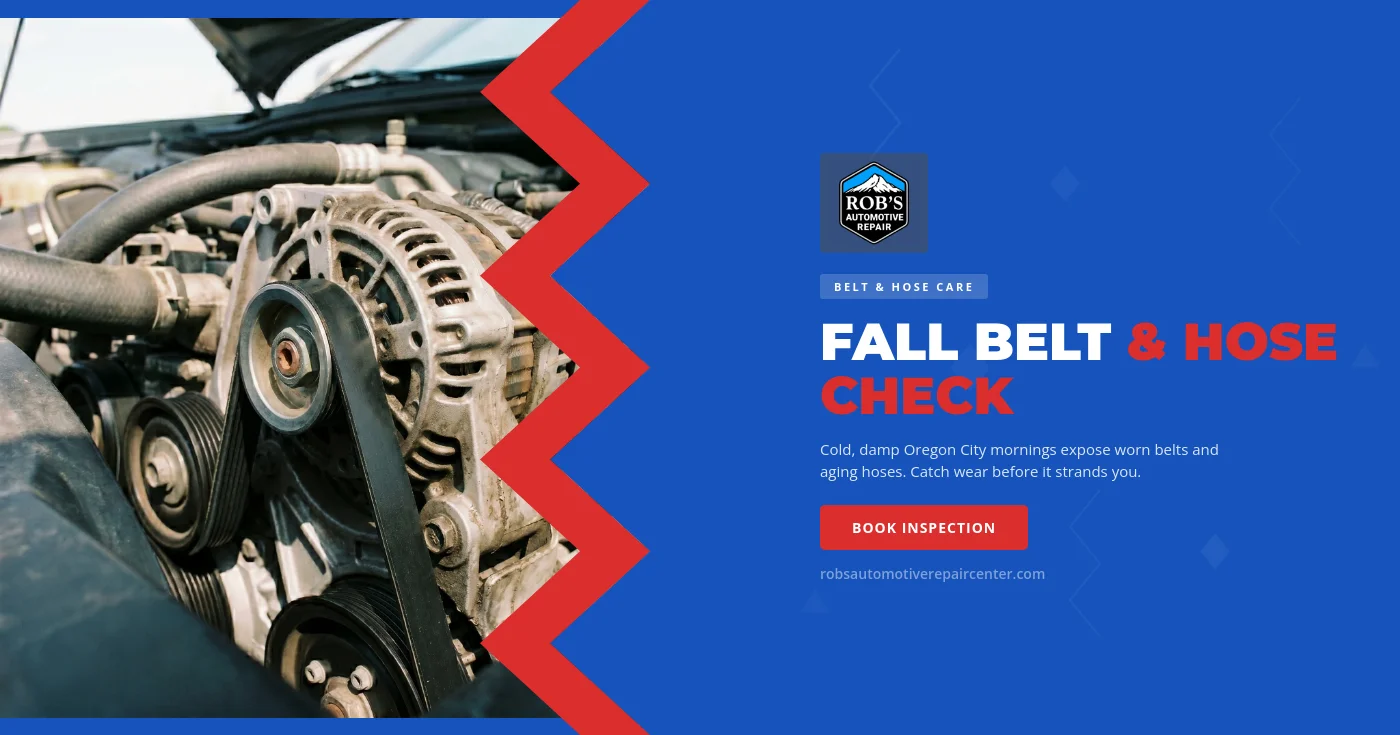
You turn the key on a foggy October morning and the engine lets out a high-pitched squeal that fades after a minute or two. By the time you merge onto I-205, it’s gone and easy to forget. But that sound is often the first warning that your belts and hoses need attention, and a belt and hose inspection is the simplest way to find out why.
Here at Rob's Automotive Repair, we see this every fall from drivers in Oregon City and across Clackamas County. Summer heat ages rubber quietly. Then the rainy season brings cold, damp mornings that expose every weakness. A worn belt slips, a tired coolant hose softens, and a routine commute turns into a roadside wait.
In this post, we’ll explain why fall weather is so hard on these parts, what a squealing belt really means, how to spot a failing hose, what our inspection covers and when to replace parts before winter.
Why Fall Weather in Oregon City Is Hard on Belts and Hoses
Rubber parts under your hood live a tough life. Through July and August, engine bays bake, and that heat slowly hardens belts and breaks down hoses without causing an immediate failure. By the time fall shows up, the damage is done. The weather just reveals it.
October typically marks the start of the rainy season in the Willamette Valley. Rain becomes far more frequent, and overnight lows often dip into the 40s. (For exact local figures, the National Weather Service in Portland keeps climate records.) Mornings near the Willamette and Clackamas rivers bring fog and heavy dew, and that moisture settles right on your belt and pulleys.
That combination matters for three reasons:
- Cold rubber is stiffer. A belt that has lost flexibility grips poorly until it warms up.
- Moisture reduces friction. Water between the belt and pulleys makes slipping more likely, especially on a worn belt.
- Heater and defroster demand rises. Running climate controls in wet weather adds load to the cooling system and accessory drive.
Add daily commutes on OR-213, OR-99E and I-205, plus weekend trips over Mt. Hood, and fall becomes the ideal window for a belt and hose inspection, catching summer damage before the first freezes arrive in November and December.
The Serpentine Belt Squeal on Cold, Damp Mornings: What It Means
A squealing belt on a cold morning is one of the most common complaints we hear. In most cases, the belt is slipping on one or more pulleys. When moisture and cold reduce grip, a belt in good condition with proper tension usually holds on. A worn belt, a weak drive belt tensioner or a slightly misaligned pulley can’t compensate, so it slips and squeals.
A squeal that stops once the engine warms up is a classic early warning. It doesn’t always mean the belt is about to snap, but it does mean something in the system is no longer working as designed.
Why “No Cracks” Doesn’t Mean “No Wear”
Here’s a point many drivers miss. Older neoprene belts cracked visibly as they aged, so a quick look told you a lot. Most modern serpentine belts are made of EPDM rubber, which tends to wear more like a tire tread, losing material from the ribs over time. According to belt manufacturer Gates, an EPDM belt can look clean and crack-free while its ribs are worn too thin to grip properly. That’s why our technicians measure rib depth with a gauge rather than relying on appearance alone.
Skip the Belt Dressing
Spray-on belt dressing may quiet a squeal for a few days, but it only masks the cause, and some products can leave residue that shortens belt life. The real fix is finding out why the belt is slipping.
Warning Signs of Cracked, Soft or Swollen Coolant Hoses
Coolant hoses carry hot, pressurized fluid between your engine, radiator and heater core. Unlike belts, hoses often fail from the inside out. A process called electrochemical degradation (ECD) can create tiny cracks along the inner wall, usually near the ends where the hose clamps on. The outside may look fine while the inside deteriorates.
Signs that you may need radiator hose replacement include:
- Soft or mushy spots, especially within an inch or two of the clamps
- Swelling or bulging when the engine is warm
- Hardness or brittleness, often from years of heat
- Visible cracks or a rough, checked surface
- White or green crust around fittings, a sign of a slow coolant hose leak
- A sweet smell or drops of coolant under the car
A Quick Check You Can Do at Home
With the engine completely cool, gently squeeze each hose near its ends. A healthy hose feels firm but flexible. If it feels spongy, crunchy or noticeably different from the middle of the hose, have it looked at. Never open the radiator cap or handle hoses on a hot engine. The system is under pressure, and hot coolant can cause serious burns.
A belt and hose inspection catches these problems early, and if we find hose damage, we also check the radiator, thermostat and coolant condition so nothing gets missed.
What Happens When a Belt or Hose Fails on the Road
On many engines, a single serpentine belt drives the alternator, power steering pump, A/C compressor and sometimes the water pump. The Car Care Council points out that when this one belt breaks, several systems can quit at once. So what happens if a serpentine belt breaks while driving?
- Your battery stops charging. The alternator no longer turns, so the car runs on battery power until it drains.
- Steering gets heavy. On vehicles with hydraulic power steering, turning the wheel suddenly takes real effort.
- The engine can overheat. If the belt drives the water pump, coolant stops circulating.
- Defrost performance drops. That’s a visibility problem on a rainy fall morning.
A burst coolant hose is just as disruptive. Coolant can empty in moments, and the temperature gauge climbs fast. Continuing to drive an overheating engine can warp the cylinder head or damage the head gasket, turning a modest hose repair into a major engine bill.
Picture losing power steering on the Abernethy Bridge in the rain, or watching steam pour from the hood on a narrow I-205 shoulder. If the temperature spikes or a warning light appears, pull over somewhere secure and shut the engine off. A battery or charging light can also point to alternator trouble, which our Electrical and Starter Repair team can diagnose.
What a Professional Belt and Hose Inspection Covers
A thorough belt and hose inspection goes well beyond a glance under the hood. Here at Rob's Automotive Repair, our ASE Certified and Dealer Certified technicians follow a consistent process, and every vehicle gets a courtesy inspection. With our digital inspections, you see photos of what we see, so you can make informed decisions.
A typical inspection includes:
- Serpentine and accessory belts: rib depth, glazing, fraying, chunking and oil or coolant contamination
- Belt routing and tension: confirming the belt sits correctly on every pulley and the tensioner holds steady pressure
- Upper and lower radiator hoses: feel, flexibility, swelling and signs of ECD near the clamps
- Heater and bypass hoses: often overlooked and harder to reach
- Clamps and connections: corrosion, looseness and seepage
- Coolant level and condition: low or contaminated coolant can point to hidden leaks
- Pressure testing when needed: to find leaks that only appear under heat and pressure
Timing belts are a separate service. They sit behind covers and follow their own replacement interval, so we’ll tell you where yours stands based on your vehicle’s schedule.
Because we run a large shop with a full staff, we can usually get you in faster than you might expect, which helps when a squeal shows up midweek.
Tensioners, Pulleys and Clamps: The Parts That Fail Alongside Belts
A belt is only as good as the parts that guide and tension it. Most modern engines use an automatic drive belt tensioner, a spring-loaded arm that keeps the belt at the right tightness. Over time the spring weakens and the internal damper wears out.
Signs of a tired tensioner or idler pulley include:
- Chirping or ticking that changes with engine speed
- A belt that visibly flutters at idle
- A tensioner arm that bounces or shakes
- Grinding or rumbling from a pulley bearing
- Uneven wear along one edge of the belt
Installing a new belt on a worn tensioner is like putting new tires on a car with bad alignment: the new part wears out early. That’s why serpentine belt replacement at higher mileage often includes the tensioner and idler pulleys. We’ll show you measurements and photos so you can decide what makes sense.
Hose clamps deserve attention too. Older worm-gear clamps can loosen as rubber shrinks, and spring clamps lose tension after years of heat cycles. A loose clamp seeps coolant slowly, leaving crusty residue around fittings. When we replace hoses, we check or replace clamps so the new hose seals properly.
When to Replace Belts and Hoses Before Winter Arrives
How often should car belts and hoses be replaced? General industry guidance, including from the Car Care Council, suggests serpentine belts often last somewhere between 60,000 and 100,000 miles, while coolant hoses commonly last around four to five years. Those are rough ranges, not rules. Your owner’s manual and driving conditions matter more than any single number.
We recommend replacing belts and hoses ahead of winter if:
- Your belt squeals on cold or wet mornings
- Rib depth measures near the wear limit
- Any hose feels soft, swollen or brittle
- You see coolant residue or puddles
- You’re planning winter trips over the mountains
Pairing a belt and hose inspection with your Factory Scheduled Maintenance visit is an easy way to stay ahead. We can check both at once and flag anything close to due.
Timing matters. Replacing a hose in October on your schedule is far easier than dealing with a burst hose during a December cold snap. When we do the work, you’re covered by our 4-year/48,000-mile local warranty plus a 3-year/36,000-mile nationwide warranty, and you earn 3% back through our rewards program.
Frequently Asked Questions About Belt and Hose Inspection in Oregon City
Why does my serpentine belt squeal on cold mornings?
Cold stiffens the rubber and moisture reduces grip on the pulleys. A belt in good shape with a healthy tensioner usually holds; a worn belt or weak tensioner slips and squeals until everything warms up.
Can I keep driving with a squealing belt?
Usually for a short time, but treat it as a warning, not a nuisance. A slipping belt may not charge your battery fully, and a worn belt can break without further notice. We recommend getting it checked soon.
How long does a belt and hose inspection take?
It’s often quick, and it’s part of the courtesy inspection we perform on every vehicle. If we find an issue, we’ll share photos and an estimate before doing any work.
Do you offer belt and hose inspection for Oregon City drivers?
Yes. We serve Oregon City, Clackamas, Happy Valley, Milwaukie, Damascus and Boring, and many of our Oregon City customers stop in on their way to or from work.
Schedule Your Belt and Hose Inspection Before the First Freeze
A squeal on a foggy morning or a soft spot on a hose is your car asking for attention. Catching it now costs far less, in time and money, than a breakdown on a wet shoulder. For 21 years, Rob's Automotive Repair has helped drivers across Clackamas, Oregon City, Happy Valley, Milwaukie, Damascus and Boring keep their vehicles dependable through every season.
Contact us today to schedule your belt and hose inspection, and our friendly service advisors will get you in fast and back on the road with peace of mind.
Is it time for a belt and hose inspection on my car?
If your engine squeals on cold, damp mornings or you can’t remember the last time your hoses were checked, the answer is probably yes. Fall is when summer heat damage shows up, and we’d much rather catch a worn belt or soft hose in our shop than have you find it on the side of the road.
Here’s what we look at during every belt and hose inspection:
- Serpentine belt wear: we measure rib depth, because modern belts can look fine while being worn out
- Tensioners and pulleys: weak tensioners cause slipping, chirping and early belt wear
- Radiator and heater hoses: we check for softness, swelling and cracks near the clamps
- Clamps and coolant: loose connections and low coolant can point to hidden leaks
Our ASE Certified and Dealer Certified technicians use digital inspections, so you’ll see photos of exactly what we find before any work begins. Every vehicle gets a courtesy inspection, and because we run a large shop with a full staff, we can usually get you in faster.
When repairs are needed, we back them with our 4-year/48,000-mile local warranty and 3-year/36,000-mile nationwide warranty, and you earn 3% back through our rewards program.
Want the full rundown on why fall weather is so tough on belts and hoses? Read our complete guide to fall belt and hose inspections.