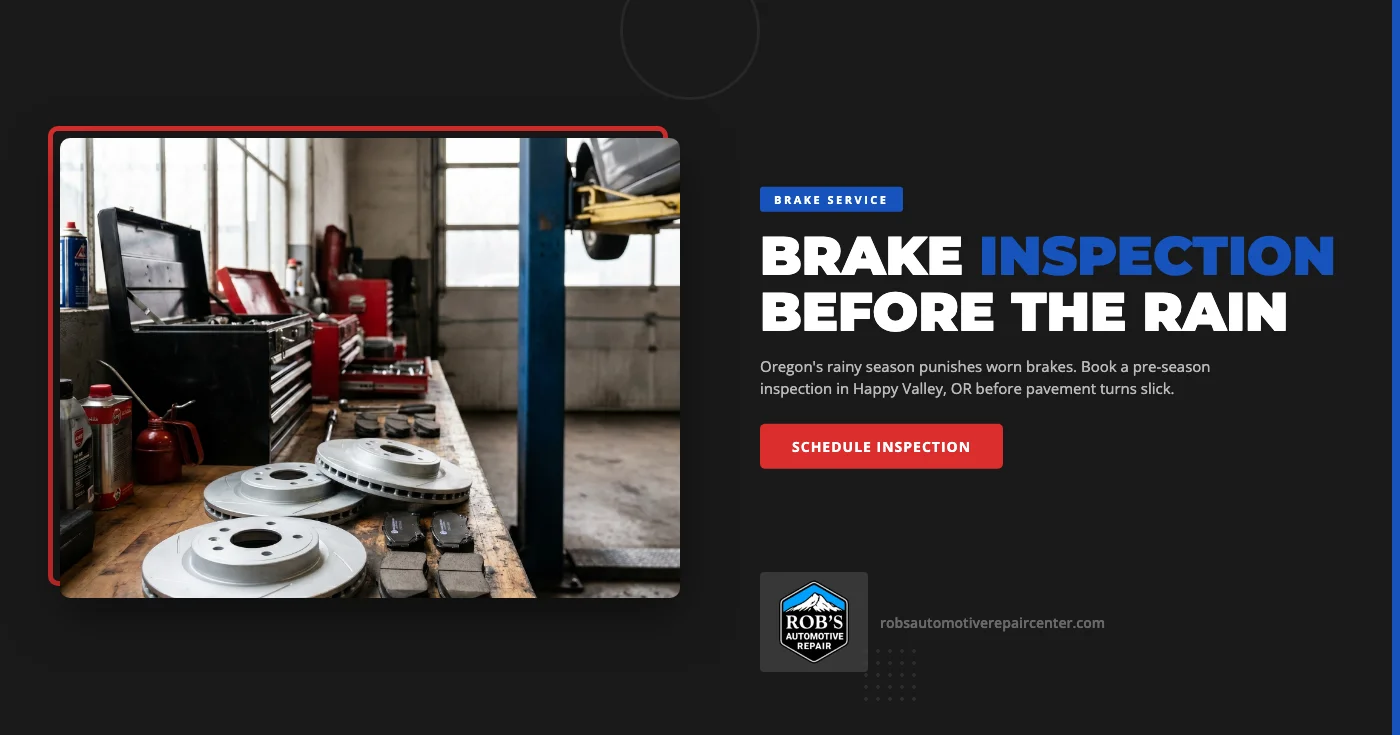
Happy Valley pavement in July doesn't tell the same story it will in October. The climb up Scouters Mountain and the descent toward I-205 bake dry in the afternoon and stop clean now. Two months from now, the first serious storm rolls off the Willamette Valley and everything changes — puddles at every low spot, wet leaves on the shoulder, and brake pads that felt fine in August suddenly grabbing later and unevenly. A pre-season brake inspection happy valley or drivers can rely on catches the small stuff — a glazed pad, a scored rotor, a slow-leaking caliper — while the pavement is still dry enough to test the fix.
At Rob's Automotive Repair, we've cared for Happy Valley, Clackamas, Milwaukie, Oregon City, Damascus, and Boring drivers for 21 years from our Highway 212 shop. Our ASE Certified and dealer-trained technicians run a full brake walk-through with every visit and email a courtesy digital report to your inbox — photos of anything we flag — before you leave.
Why Oregon's Rainy Season Is Hard on Brakes
Wet weather works your brakes harder than dry — and Pacific Northwest fall gives you eight straight months of it. Every stop takes longer, and every mile of wet pavement adds fine grit that grinds against the rotor. Small wear that summer heat hides gets amplified the day the roads turn slick.
- Wet-road stopping distance grows. Wet pavement adds meaningful feet to a stop from freeway speed. A worn pad or glazed rotor turns that reasonable margin into an anxious one.
- Water on the rotor thins the friction film. The first firm brake application after a puddle wipes moisture off the rotor face. If the pad is glazed, that wipe takes longer and initial bite feels vague.
- Grit and road slurry accelerate wear. Fall rain lifts summer's oil residue and fine grit off the asphalt and pushes it between pad and rotor. Both wear faster the wetter the road stays.
- Caliper slides seize. Damp air and road spray corrode the slide pins that let the caliper float. A stuck slide means one pad does most of the work — uneven wear, pulling under braking, and a shorter pad life on that corner.
Signs Your Brakes Need Attention Before the Rains Hit in Happy Valley
Brake wear usually announces itself in feel and sound before it becomes an emergency — but the cues are easy to explain away in summer, when stops are short and traffic is light. What our technicians watch for, and what a Happy Valley driver can catch:
- Squeal or chirp at the end of a normal stop. Modern pads have a wear indicator — a small metal tab that scrapes the rotor as the pad thins. A steady chirp at low speed is that tab telling you replacement is close.
- Grinding or metallic sound. When the squeal turns to grinding, the pad has worn through and the backing plate is scoring the rotor. Every stop after that costs money a routine pad change wouldn't have.
- Pedal that sinks under steady foot pressure. A pedal that slowly drops at a stoplight points to a master-cylinder leak or air in the hydraulic system — both call for the car to come in before the next long drive.
- Pulling to one side under braking. If the car steps left or right when you brake, one corner is doing more of the work — usually a seized slide pin, a collapsed hose, or a piston that isn't retracting.
- Vibration through the pedal at freeway speeds. Warped rotors show up as a rhythmic pulse. Rotors warp from repeated overheating or from bolt torque that wasn't set to spec at the last tire install.
- Burning smell after a long downhill. A sharp acrid smell coming off Scouters Mountain or Mt. Scott is friction glazing the pad. If it keeps happening, the pads or the fluid — or both — are near their heat limit.
One symptom alone can be nothing serious. Two together means brake service happy valley oregon drivers should book this week, before wet roads make the margin any thinner.
What a Professional Brake Inspection Covers at Rob's Automotive
A full fall brake check oregon drivers book at our Highway 212 shop is the same brake walk-through we run on every courtesy inspection — measuring pad and rotor condition, testing the hydraulics, and photographing anything that needs attention.
- Pad thickness measurement. Inside and outside pads on all four corners, measured in millimeters against manufacturer minimum. We record the number so the next visit has a baseline and you know how many miles the current pads have left.
- Rotor condition and thickness. A micrometer check verifies each rotor is above the discard spec stamped on it. We inspect for scoring, heat spotting, hard-spot bluing, and lip build-up on the outer edge.
- Caliper and slide-pin inspection. Piston boots are checked for cracks and tears, slide pins pulled and re-greased if stuck, and the caliper checked for even piston retraction. Uneven pad wear side-to-side is the first tell of a stuck slide.
- Brake hose and hard-line check. Rubber hoses are flexed and inspected for bulging, cracking, or ballooning under pressure. Hard lines are traced for corrosion or damage.
- Brake fluid condition and level. A test strip reads copper content — a proxy for how much moisture the fluid has absorbed. Fluid past 3 percent moisture lowers the boiling point enough to fade under sustained braking on a descent.
- Post-inspection test drive. A short loop verifies pedal feel, straight-line stopping, and any noise or vibration under braking on wet pavement.
Everything the inspection flags is photographed and written into a digital report emailed to your inbox before you leave. We quote any recommended repair up front — no work happens without your OK. If the inspection calls for a full Brake Service, we handle it in the same visit whenever parts are on the shelf.
Drum vs. Disc Brakes: Which Wears Faster in Wet Pacific Northwest Conditions?
Most cars sold in the last fifteen years use disc brakes on all four wheels, but plenty of trucks and older sedans still run rear drums. The two designs handle rain and grit differently — and knowing which you have shapes how often to book.
Disc brakes use a pad that clamps a spinning rotor from both sides. The design is open — water, air, and debris pass through freely. That's a strength in wet weather: rotors dry off within a stop or two, heat dissipates cleanly, and inspection is a matter of looking. The trade-off is that the same openness lets grit reach the friction surfaces directly, so disc pads wear faster than drum shoes of the same size.
Drum brakes enclose the friction shoes inside a metal drum. Water and grit that make it inside stay inside — a drum that has been through a puddle can hold moisture against the shoes for miles. The upside is that drums shed heat more slowly and self-adjust as the shoes wear, which is why manufacturers still use them on rear axles that see less braking load.
In Pacific Northwest fall, disc brakes shrug off wet weather quickly but need pad-thickness checks more often. Drums stay drier from spray but should be pulled and inspected once a year for accumulated dust and rust — hidden wear a Happy Valley driver won't catch by feel until a shoe seizes on a wet morning. Whichever design your car uses, brake repair clackamas area drivers trust starts with the correct diagnosis for the setup on the car. Uneven tire wear also throws off load balance the brakes have to compensate for — a fresh Wheel Alignment keeps that from becoming a brake issue.
How Often Should Happy Valley, OR Drivers Schedule Brake Service?
The straight answer to "how often should i get my brakes checked in happy valley or" is: with every oil change. A courtesy brake walk-through rides along with every service visit at our shop, so drivers on a regular oil-change schedule already get four measurements a year. Some situations push a Happy Valley driver toward a standalone brakes for rainy season happy valley or check:
- Any symptom above. Squeal, grind, pulling, vibration, or a slowly sinking pedal — don't wait for the next oil-change window.
- Recent long descent. A trip off Mt. Hood or repeated hard braking down Scouters Mountain generates heat that can glaze pads or warp a marginal rotor. Book a check afterward.
- New tires just installed. A tire install is when rotor bolts get retorqued. A shop that skips the torque spec can warp a rotor in a week. If the pedal pulses after a tire install, come in.
- Heavy hauling or towing. Trucks and fleet vehicles that regularly haul or tow should skew shorter — every three to four months is more realistic than annual.
- Vehicle past 50,000 miles on the current pads. Most pad sets are engineered for 30,000 to 70,000 miles. Past the halfway point, measurement matters more than time on the calendar.
Regular checks also catch problems that quietly cost you fuel. A dragging caliper keeps a pad in light contact with the rotor — the U.S. Department of Energy's fuel-economy maintenance guidance notes that keeping a vehicle properly serviced protects MPG and heads off expensive repairs. A stuck slide pin is a textbook example. On brake inspection cost happy valley oregon pricing: our courtesy inspection is included with every service visit; a standalone inspection is quoted up front. New customers get 20% off the first visit.
Frequently Asked Questions About Brake Inspection in Happy Valley, OR
How much does a brake inspection cost at Rob's Automotive Repair?
A courtesy brake inspection rides along with every service visit — oil change, tire rotation, or otherwise. Standalone inspections are quoted up front. New customers get 20% off the first visit, and every service earns 3% back through our rewards program.
How long does a professional brake inspection take?
Roughly 45 minutes to an hour for a full four-wheel measurement and hydraulic check. Paired with an oil change and a courtesy multi-point, the whole visit usually wraps in under two hours.
What are the first warning signs I need brake service?
A high-pitched squeal at low speed, a soft or slowly sinking pedal, pulling to one side under braking, or a pedal vibration at freeway speeds. Any one of those is worth a check. Two together means book this week.
Should I get a brake inspection before winter in Oregon?
Yes. Rainy-season pavement demands more of every brake system, and worn pads or aging fluid that got by all summer are the parts that fail first once the roads turn slick. Booking in September catches wear while diagnosis and repair happen on dry pavement.
Where can I find the best brake service near Clackamas OR?
Rob's Automotive Repair on Highway 212 — a short hop off I-205 — runs every brake inspection as a full four-wheel measurement with photos and backs the repair with our 4-year/48,000-mile local warranty and 3-year/36,000-mile nationwide coverage. Monday through Friday, 7 am to 6 pm.
Schedule Your Pre-Rainy Season Brake Inspection at Rob's in Happy Valley, OR
The dry weeks before the first serious October storm are the right window to get a full brake inspection done in daylight and on dry pavement. Waiting until the pedal is already sinking on a wet Monday turns a scheduled hour in a warm bay into a stressful roadside decision. If it has been more than six months since your last brake check — or you have noticed a squeal, a grind, a pulling car, or a soft pedal — book this month. Stop by our Highway 212 shop or book online. Every brake repair is backed by our 4-year/48,000-mile local warranty and 3-year/36,000-mile nationwide coverage on parts and labor, and Rob's Automotive Repair has served Happy Valley, Clackamas, Milwaukie, Oregon City, Damascus, and Boring drivers from the same shop since 2005.