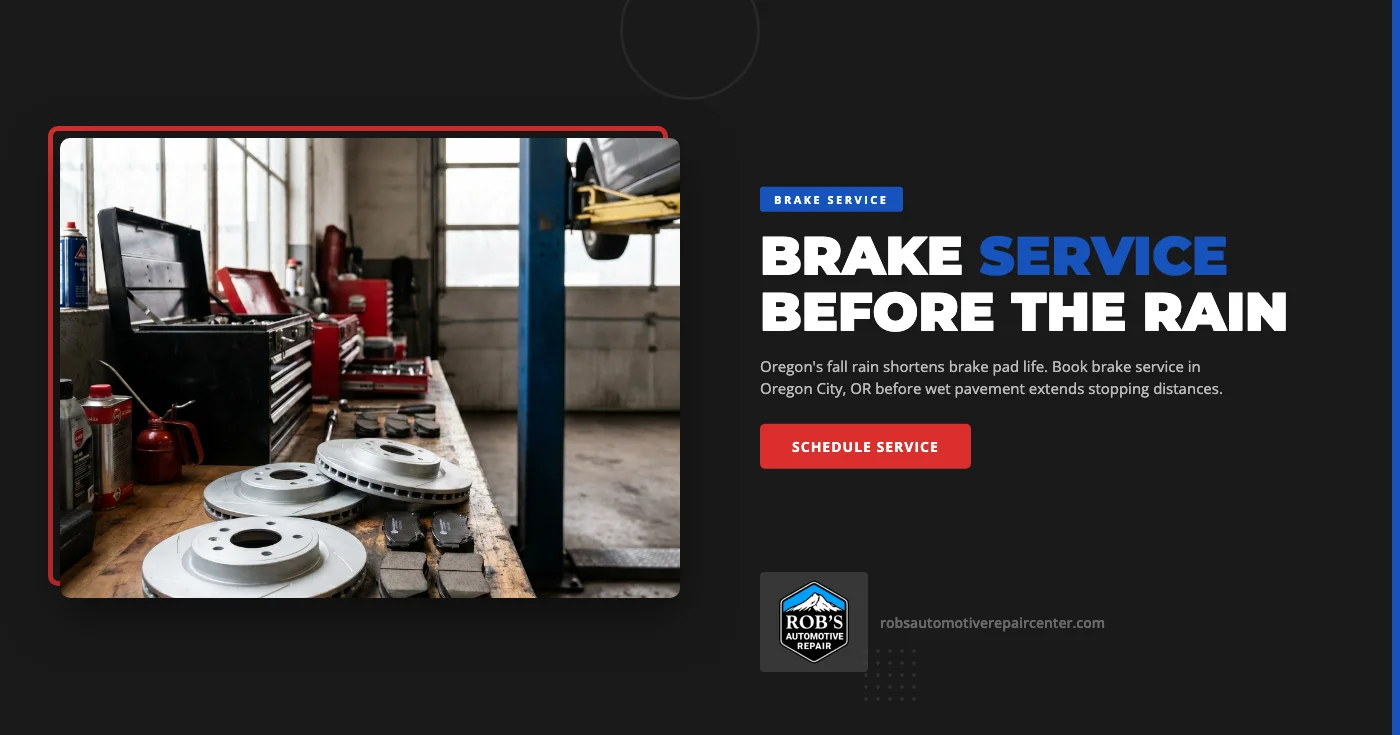
Oregon City pavement changes character every October. The bluff climb off McLoughlin, the descent into Gladstone, the wet curves along 213 — none of it stops the way it did in July. The first Pacific Northwest storm rolls in, summer's baked-in road oil lifts to the surface, and every worn brake pad, glazed rotor, and moisture-loaded fluid line that got by all summer suddenly matters. A pre-season brake service oregon city or drivers can book while the pavement is still dry is the difference between a scheduled hour in a warm bay and a stressful call from a wet shoulder in November.
At Rob's Automotive Repair, we've served Oregon City, Clackamas, Milwaukie, and Happy Valley drivers for 21 years from our shop on Highway 212. Our ASE Certified technicians run a full brake walk-through with every courtesy inspection and email a digital report with photos before you leave.
How Oregon's Fall Rain Season Puts Extra Stress on Your Brake System
Brake systems are engineered for wet weather, but Pacific Northwest fall pushes them hard. The Oregon Department of Transportation notes a car needs two to three times more stopping distance on wet roads, and hydroplaning can start at speeds as low as 35 mph on worn tires. Oregon City averages roughly four inches of rain in October alone, then more in November — eight straight months where every stop takes longer than on dry pavement.
Rain works on the brakes in three ways our technicians look for during a fall brake inspection oregon city drivers book at our Highway 212 shop:
- Surface rust on rotors. Overnight rain leaves a thin oxidized film on the rotor face. Most mornings the first brake application scrubs it off, but when a vehicle sits outside for a week the rust penetrates deeper — enough to cause pulsation, uneven pad wear, and vague initial bite.
- Water in the brake fluid. Brake fluid is hygroscopic — it pulls moisture out of the air, and Pacific Northwest humidity accelerates the process. Water lowers the boiling point, which is exactly what you don't want descending the Oregon City bluff.
- Grit, leaves, and first-rain oil slick. The first rain after a dry spell is the most hazardous drive of the season. Summer's engine grease lifts off the asphalt and turns wet pavement into a skating rink until the road washes clean. Every stop that day loads the front brakes harder than they were designed for.
None of this is a fault in the brake design — it's the math of a climate that swings from dry August into eight months of wet. A system that lasts 60,000 miles for an Arizona driver often makes it only to 40,000 in Clackamas County.
The Most Common Warning Signs That Your Brakes Need Attention
Brake wear rarely announces itself all at once. Most vehicles give quieter warnings for weeks or months before anything breaks — and the earlier we catch them, the less expensive the repair.
- Squeal or chirp at the end of a normal stop. Modern pads have a wear indicator — a small metal tab that scrapes the rotor as the pad thins. A steady chirp is that tab telling you replacement is coming due. A warning, not an emergency, but it should trigger a booking within a few weeks.
- Grinding or metal-on-metal noise. When squeal turns to grinding, the pad has worn through and the backing plate is scoring the rotor. Every stop after that costs money a routine pad change would have prevented.
- Pedal that sinks under steady pressure. A pedal that drops slowly at a red light points to a master-cylinder leak or air in the hydraulic system. Both call for the car to come in before your next long drive.
- Pulling to one side under braking. If the vehicle drifts when you brake, one corner is doing more of the work — usually a stuck slide pin or a piston that isn't retracting.
- Vibration through the pedal or steering wheel. Warped rotors show up as a rhythmic pulse under braking. Rotors warp from repeated overheating on long descents or from wheel torque that wasn't set to spec.
- Burning smell after a long downhill. A sharp acrid smell after descending the Oregon City bluff is friction glazing the pad. If it happens more than once, the pads or the fluid are near their heat limit.
One symptom alone can be nothing serious. Two together, or one that keeps getting worse, means it's time to book. Our team offers a free brake inspection so drivers can catch these signs on their own schedule.
Understanding Brake Pad Wear Rates on Oregon City's Hilly Terrain
Oregon City is not flat. The bluff between downtown and the upper part of town, the Redland grades, and the constant climb-and-drop along 213 put the front brakes under sustained load a driver in a flat suburb never encounters. Combine that with wet leaves and stop-and-go into Portland, and you get accelerated brake pads oregon city or wear that surprises newer residents every fall.
Manufacturer estimates put pad life between 30,000 and 70,000 miles. In our experience serving Clackamas County, most vehicles land closer to the low end:
- Descending grades. Every trip down the Oregon City bluff or the 213 grade applies sustained pressure on the front brakes. Front pads on hill-country vehicles wear 30 to 40 percent faster than on flat terrain.
- Frequent short trips. Home, school, grocery store, home. Brakes never fully dry out, and damp friction surfaces mean more corrosion between drives.
- Vehicle weight. Trucks and SUVs put roughly twice the load on the brake system as compact sedans. SUVs that also tow can burn through pads in 25,000 miles.
- Driving style. Riding the pedal, late braking, and heavy hauling all shorten pad life.
Because the range is so wide, mileage alone isn't a reliable trigger. We recommend a fall brake repair clackamas or shop check — pad thickness, rotor scan, fluid moisture test — every year, ideally before the wet season peaks in mid-November.
What a Professional Brake Inspection at Rob's Automotive Includes
Not every "brake inspection" looks the same across auto shops. When you bring your vehicle to us for rob's automotive brake service, our ASE Certified technicians run a structured process designed to catch problems before they become emergencies:
- Digital courtesy inspection. Every vehicle gets a full walk-through with photos of pad thickness, rotor condition, caliper function, and fluid level. You see the wear patterns yourself.
- Pad thickness measurement. Inside and outside pads on all four corners, measured in millimeters against the manufacturer minimum. New pads start around 10 to 12 mm; replacement is typically recommended around 3 mm.
- Rotor thickness and runout check. A micrometer verifies each rotor is above the discard spec. We inspect for scoring, heat spotting, hard-spot bluing, and lip build-up.
- Brake fluid moisture test. A digital tester reads water content. Anything over 3 percent moisture calls for a fluid flush — especially critical where humidity is constant.
- Caliper and hardware review. Sticking calipers, corroded slide pins, cracked piston boots, and worn clips are common in rainy climates and cause uneven pad wear.
- Post-inspection test drive. A short loop confirms pedal feel, straight-line stopping, and any noise or vibration under real conditions.
Everything we flag is photographed and written into a digital report emailed to your inbox before you leave. We quote any recommended repair up front — no work happens without your OK. Every brake job is backed by our 4-year / 48,000-mile local warranty and 3-year / 36,000-mile nationwide coverage. If you're due for other fall maintenance, we can bundle brake service with an oil change, tire rotation, or wipers in the same visit.
Disc Brakes vs. Drum Brakes: What Oregon City Drivers Should Know
Most cars sold in the last fifteen years use disc brakes on all four wheels, but plenty of trucks and older sedans still run rear drums. The two handle wet Pacific Northwest weather differently.
Disc brakes use a pad that clamps a spinning rotor from both sides. The design is open — water, air, and heat pass through freely. Rotors dry within a stop or two and inspection is a matter of looking. The trade-off is that the same openness lets grit reach the friction surfaces, so disc pads wear faster than drum shoes.
Drum brakes use a shoe pressed outward against the inside of a spinning drum. The design is enclosed, which protects internal parts from most weather but traps moisture inside. On Oregon City vehicles that sit outside through wet nights, drum brakes tend to seize up or squeal when the vehicle first moves in the morning. Drums also self-adjust through the parking brake, so a parking brake that never gets used lets the shoes wear unevenly.
Practical takeaway: engage the parking brake regularly, have drums inspected every 24,000 miles, and consider a rear disc conversion if you tow and drum service keeps costing real money.
Frequently Asked Questions About Brake Service in Oregon City, OR
How often should I get a brake inspection in Oregon City?
At minimum, once a year. In our wet climate we recommend a brake check every fall before rain season begins, and again in early summer. Drivers who commute into Portland daily may benefit from checks every 15,000 miles.
Are squealing brakes an emergency?
Squealing is usually a warning — the wear indicator is doing its job. But it's a signal you should book brake service within a few weeks. Grinding is the emergency.
How much does brake service cost at Rob's Automotive?
Cost varies with the vehicle and how much of the system needs replacement. Pads alone are the most affordable option; pads plus rotors is common on heavier wear; full four-corner service is usually needed on vehicles overdue for care. We provide exact pricing after our free inspection.
Can I drive with a spongy brake pedal?
Not for long. A spongy pedal often means air or moisture in the brake lines — a condition that worsens quickly and can lead to brake failure. We recommend inspection the same day if possible.
Does Rob's Automotive offer a warranty on brake work?
Yes. Every brake repair is covered by our 4-year / 48,000-mile local warranty and 3-year / 36,000-mile nationwide warranty on parts and labor — one of the strongest coverage plans in the Portland metro.
Where is the best brake service near Oregon City?
Rob's Automotive Repair on Highway 212 runs every inspection as a four-wheel measurement with photos. Monday through Friday, 7 am to 6 pm.
How Long Can You Wait? A Timeline for Scheduling Brake Service This Fall
The best time to service brakes is before you notice a problem — but real life doesn't always work that way. Here's how we help Oregon City drivers decide when to book:
- Right now (September to early October). Perfect timing. Roads are still dry, our schedule has flex, and any parts we order arrive before the heavy rain. If you're above 30,000 miles since your last brake service, this is the window.
- Late October through early November. Still workable, but shop volume climbs as the rain sets in. Book at least a week ahead.
- Mid-November through December. Peak brake season. If you've been ignoring a squeal, this is when it turns into a grind. Emergency slots fill fast.
- January onward. By then, most brake failures have already happened. Repairs cost more because they usually involve rotor replacement.
New customers get 20 percent off their first visit, and every service earns 3 percent back through our rewards program. If you're not sure whether your vehicle needs attention now or can wait a few weeks, that's what the free inspection is for. Bring it in, we'll show you the measurements on your phone, and you decide next steps. Stop by our Highway 212 shop or book online. Rob's Automotive Repair has served Oregon City, Clackamas, Milwaukie, Happy Valley, and Damascus drivers from the same shop since 2005.