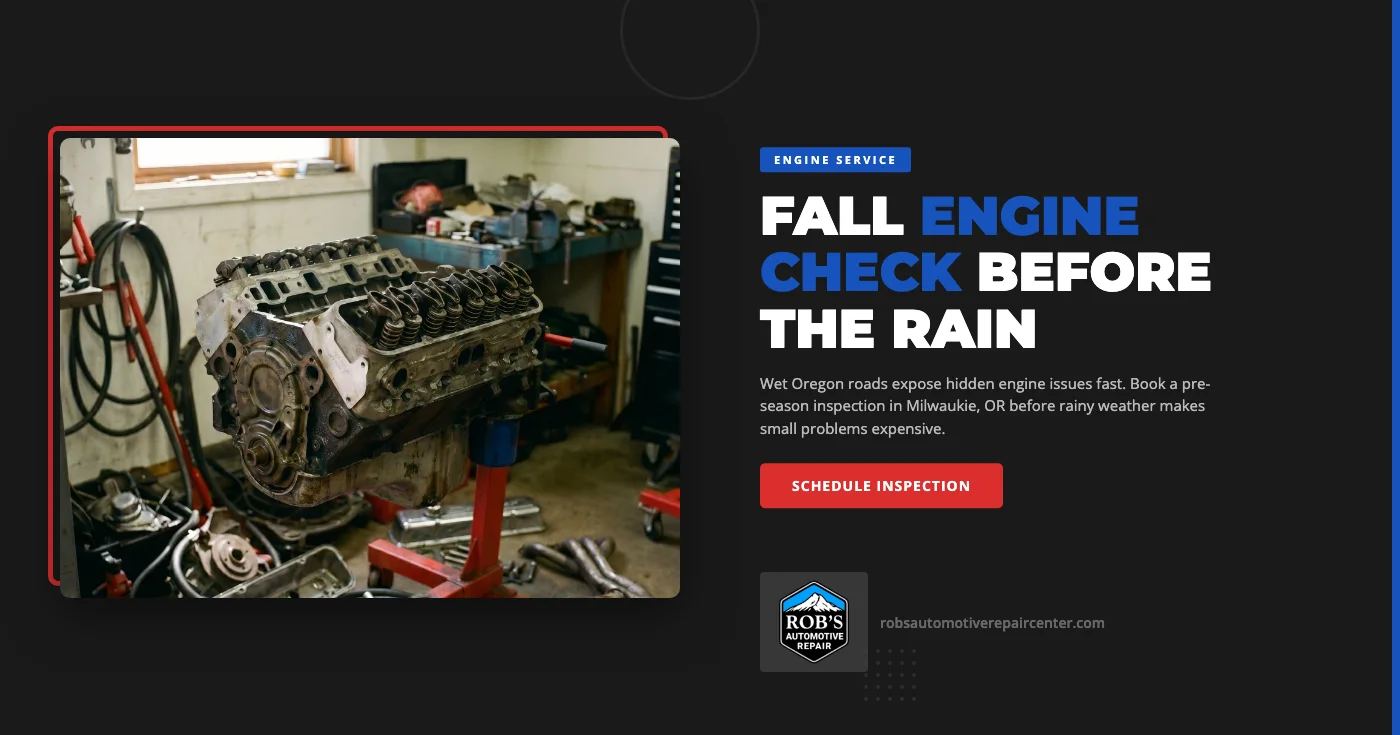
Oregon's rainy season doesn't ease in — one week the pavement in Milwaukie is dry, the next you're wiping condensation off the windshield at 7 am and creeping through wet leaves on McLoughlin Boulevard. Any engine issue quietly building through summer picks that morning to show itself. A pre-season engine service milwaukie or drivers can rely on catches those problems while it's still dry enough to diagnose them.
At Rob's Automotive Repair, we've cared for Milwaukie, Clackamas, Happy Valley, Oregon City, Damascus, and Boring drivers for 21 years from our Highway 212 shop. Our ASE Certified and dealer-trained technicians run a full engine walk-through with every visit and email a courtesy digital report to your inbox. Here's how Oregon's cool, damp weather stresses an engine, warning signs to watch for, and when to book a pre-season check.
How Oregon's Rainy Season Puts Extra Stress on Your Engine
Oregon's cool, damp autumn is a stress test for a car engine — not the raw cold of a Midwest winter, but the combination of chilly overnight lows, near-constant humidity, and short stop-and-go commutes that expose weaknesses summer heat can mask.
- Moisture on ignition components. Cool mornings condense water onto plug wires, coil boots, and distributor caps. Some spark leaks to ground instead of firing the plug — the difference between a smooth start and rough cranking on a car with worn ignition parts.
- Battery output drops with temperature. As overnight lows fall from July's mid-60s into the 40s and 30s, a battery loses a meaningful share of its cold-cranking amperage. One that spun the starter fine in August may struggle in October.
- Oil thickens and taxes the starter. Conventional and lower-grade synthetic oils grow measurably more viscous in cool weather. The first turn on a 38-degree morning pulls extra current from an already-cooler battery.
- Short trips prevent full warm-up. Fall school runs and commutes to Portland rarely give the engine time to reach operating temperature. Water vapor stays trapped in the crankcase, condensing into acid and diluting oil.
- Wet-road hours stack up fast. Fall commuters spend more time in wet conditions — more idling, more brake and throttle work per week.
Warning Signs Your Engine Needs Attention Before Fall
An engine about to become a problem in wet weather usually announces itself in July or August — quietly, in ways drivers explain away as normal. What our technicians watch for, and what a Milwaukie driver can spot before the pavement turns slick:
- Slow or hesitant cranking on cool mornings. A car turning over noticeably slower after an overnight low in the 50s is cranking on borrowed time.
- Check engine light on — even intermittently. A light that comes on, clears itself, and returns is a stored code waiting to be read. A pre-fall check engine milwaukie or visit catches a bad oxygen sensor or misfiring cylinder before it grows into a catalytic converter replacement.
- Rough idle at a stoplight. A shudder or hunt in the RPMs signals a misfire, vacuum leak, or air-fuel imbalance — all worse in cold, damp air.
- Loss of power on hills or freeway on-ramps. I-205 north from Milwaukie has grades where a weak engine hesitates under load. If the pedal needs more travel than it used to, that is data.
- Coolant smell inside or under the hood. A sweet, syrupy odor points to a leaking hose, water-pump seal, or heater core. Summer-evaporated leaks become visible drips in cool weather.
- Cracked or glazed serpentine belt. Cracks across the belt, a glazed shine, or a squeal at cold start are all replace-it-now cues.
- Rising oil consumption between changes. Adding a quart between intervals when you never used to is a leak or internal wear worth investigating.
Two or more together, and the ignition, fuel, and cooling systems deserve a proper check before daily commutes get wet.
What a Fall Engine Inspection Covers at Rob's Automotive Repair
A pre-season engine inspection milwaukie oregon drivers book at our Highway 212 shop is the full courtesy inspection our technicians run on every vehicle, focused on the engine and its supporting systems.
- Battery load test and charging-system check. A load tester measures how much current the battery can actually deliver, and we verify the alternator is charging to spec. Terminal corrosion is cleaned.
- Belt and hose inspection. The serpentine belt is checked for cracks, glazing, and correct tension. Every cooling and vacuum hose is squeezed for softness, brittleness, or bulges.
- Coolant strength and level. A refractometer confirms the coolant-to-water ratio protects against the coldest overnight lows and reports the pH — a low pH means the coolant is turning acidic and eating water-pump seals from the inside.
- Spark plugs and ignition components. Plug condition is a fast read on how the engine is burning fuel. Coils, plug wires on older cars, and the distributor cap are inspected for cracks, arcing marks, and moisture damage.
- Scan-tool code pull. A full read of stored and pending codes on engine, transmission, and ABS modules — pending codes catch a failing sensor before the check engine light triggers.
- Air, cabin, and fluid check. Air and cabin filters plus engine oil, brake fluid, power steering, transmission fluid, and washer fluid all verified. Anything dark, low, or contaminated gets flagged.
- Cooling fan and thermostat operation. The electric cooling fan is verified to cycle at spec, and the thermostat's opening point is checked so the engine reaches — and stays at — operating temperature.
Everything we find is photographed and written into a digital report emailed to your inbox before you leave. We quote any recommended work up front — no repair happens without your OK. If the report calls for a full Engine Repair, our technicians handle it in the same visit whenever parts are on the shelf.
Common Engine Problems That Surface in Oregon's Cool, Damp Weather
Every fall we see a predictable set of issues walk through the door — small summer problems that cold, damp weather turned into no-starts or larger repairs:
- Cracked ignition coils and plug wires. Heat cycles fatigue the housings, water gets into the cracks, and the coil arcs to ground on the first wet morning. A misfire code, rough idle, and hesitation on acceleration are the usual symptoms.
- Weak batteries revealed by cold cranking. A battery that turned the engine over strongly at 70-degree overnight lows can barely spin the starter at 38 degrees — one of our most common tow-ins between mid-October and Thanksgiving.
- Radiator hose failures. A hose that stayed pliable through summer stiffens overnight when temperatures drop. The next thermal cycle pops a weak spot, and coolant drips onto the driveway, then onto the belt.
- Thermostat stuck open. The engine takes forever to warm up, the heater blows lukewarm, and fuel economy drops. In summer no one notices; in October everyone does.
- Water-pump weep. The weep hole under the pump is a designed warning that the shaft seal is failing. Wet residue below the timing cover is the tell — catching it early saves the belt, tensioner, and often the timing components.
- Bad oxygen sensors. A slow O2 sensor runs the engine rich, hurting mileage and eventually the catalytic converter. Fall's cool intake temperatures highlight the mismatch.
Why Milwaukie Drivers Shouldn't Skip Pre-Season Engine Service
The commute is unforgiving in wet weather. Milwaukie drivers hit I-205, Highway 224, and McLoughlin Boulevard on wet October mornings where a stalling engine or dead battery isn't an inconvenience — it's a roadside repair in the rain. Booking a fall engine check clackamas or drivers can trust in September is the difference between a scheduled hour in a warm bay and a bad hour on a wet shoulder.
Small problems compound. A marginal coil, a weak battery, a torn boot on a plug wire — any one survives the summer. Cool, damp fall mornings make them fail together, and a straightforward part swap in September becomes a diagnostic puzzle in November.
Preventive work costs less than reactive work. The U.S. Department of Energy's fuel-economy maintenance guidance notes that fixing a serious problem like a faulty oxygen sensor can improve gas mileage by as much as 40 percent — a clean example of how catching small issues early avoids bigger downstream costs.
Warranty coverage protects the work. Any pre-winter engine repair oregon service we do is backed by our 4-year/48,000-mile local warranty and 3-year/36,000-mile nationwide warranty on parts and labor. Doing the work in September keeps the coverage fresh through the next two rainy seasons.
When to Schedule Your Engine Check Before the Rains Hit
The right window in the Milwaukie area is late August through September — after summer road trips have racked up highway miles, and before the first serious October storm. A dry test drive means a cleaner diagnosis and no rushed calls in the rain. Signals to book sooner:
- Any warning sign above. Rough idle, slow cranking, coolant smell, or an intermittent check engine light — don't wait for the light to come on again.
- Overdue on an oil change. An oil service and courtesy engine inspection ride together. If it's been more than 5,000 miles or six months, book them together.
- Recent no-start or jump-start. One jump doesn't fix the underlying cause. Get the charging system tested before the next cool morning tells the same story.
- Vehicle at 75,000+ miles. The wear items that fail first — belts, hoses, plugs, batteries, water pumps — are on their second lap. Diesel owners specifically benefit from a fall glow-plug and fuel-filter check.
Our answer to "when to get engine inspected before fall in milwaukie or" is straightforward: pick a dry weekday in September, book it alongside the oil change you're already due for, and get the digital report before the storms roll in.
Frequently Asked Questions About Fall Engine Inspection in Milwaukie, OR
What should I check on my engine before Oregon rainy season?
Battery condition and terminal cleanliness, coolant strength and level, all belts and hoses, spark plug condition, and any stored diagnostic codes. If you aren't comfortable pulling codes or load-testing a battery, a scheduled inspection covers all of it and produces a written record.
How much does a fall engine inspection cost at Rob's Automotive Repair?
A courtesy inspection comes with every service visit — oil change, brake job, or otherwise. For a standalone engine inspection, call the shop and we'll quote it up front. New customers get 20% off the first visit.
Does a check engine light always mean something serious?
Not always, but always worth reading. A light can trigger from a loose gas cap or a failing catalytic converter. A quick Auto Diagnostics scan tells you which end of that range you're on before it grows.
How often should I get an engine inspected in Milwaukie, OR?
Twice a year — once in spring, once in fall. A courtesy inspection with every oil change means drivers on a regular service schedule already have this covered.
Where can I get engine service near Milwaukie, OR?
Rob's Automotive Repair on Highway 212 in Clackamas — a short hop off I-205 — runs a courtesy digital inspection with every visit and backs the work with our 4-year/48,000-mile local warranty and 3-year/36,000-mile nationwide warranty. Open Monday through Friday, 7 am to 6 pm.
Book Your Fall Engine Inspection Near Milwaukie Before the Rains Arrive
The dry weeks before the first serious October storm are the right window to get a full engine check done in daylight, on dry pavement. Waiting until the car strands you in the rain turns a scheduled inspection into a tow bill. If it's been more than six months since your last full engine check — or you've noticed slow cranking, a check engine light, a coolant smell, or a rough idle — book this month. Stop by our Highway 212 shop in Clackamas or book online. We'll back the work with the warranty coverage that has kept Milwaukie, Clackamas, Happy Valley, Oregon City, Damascus, and Boring drivers coming back since 2005.