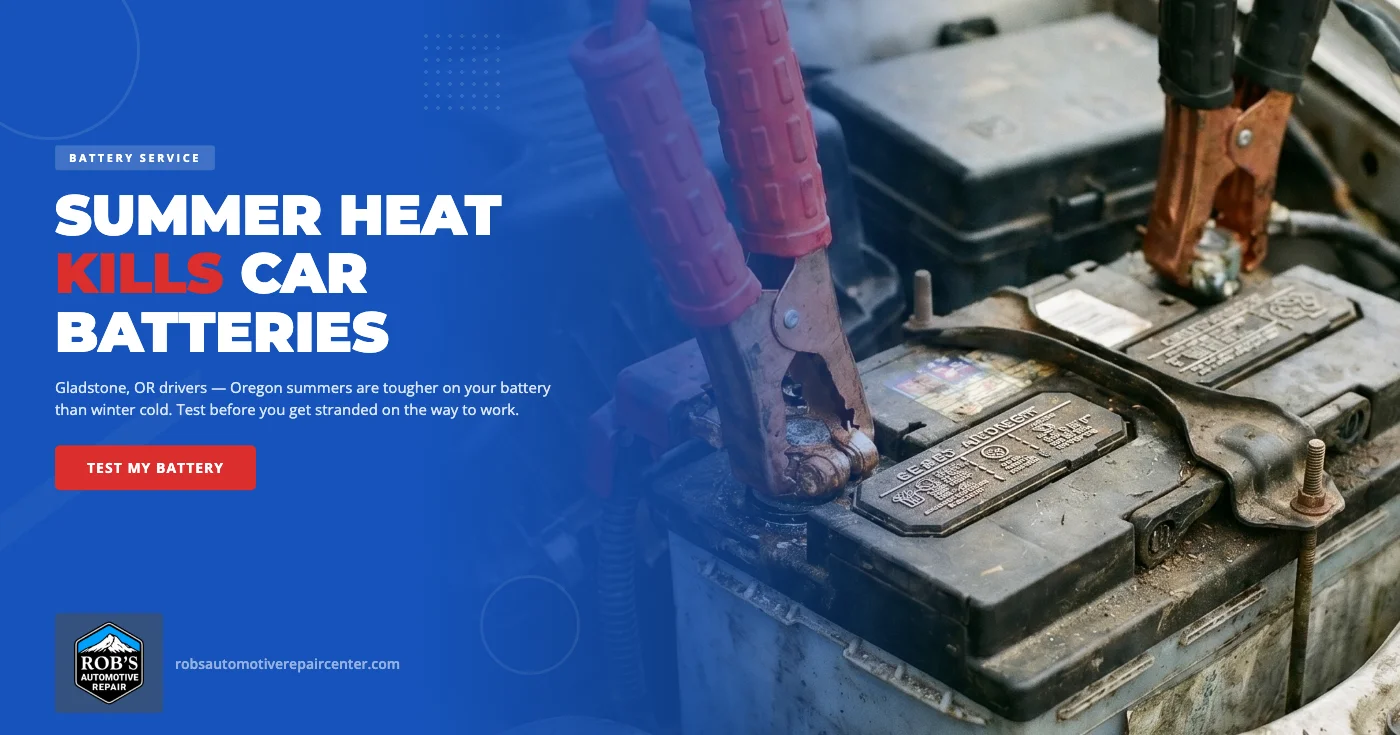
A Gladstone driver leaves the office on a 92-degree July afternoon, hits the unlock button, slides in, and turns the key — and gets a single click, then nothing. The battery tested fine in February. It started the car this morning. By 5 p.m. it's dead in the parking lot. That sequence is the most common roadside scene we see all summer, and it isn't bad luck: Oregon's warm-weather months do more long-term damage to a car battery than the wettest winter Gladstone has on record. A pre-summer or mid-summer car battery replacement Gladstone OR check is the cheapest insurance against ending up next on AAA's tow list.
At Rob's Automotive Repair, we've kept Gladstone, Clackamas, Oregon City, Milwaukie, Happy Valley, and Damascus drivers rolling for 21 years from the same Highway 212 location. Every visit includes a complimentary courtesy inspection with a battery and charging-system test, and our ASE Certified and dealer-certified technicians handle everything from a worn 12-volt lead-acid replacement to the high-voltage systems in modern hybrids. Here's what every Gladstone driver should understand about summer batteries before the dash light comes on.
Why Summer Heat Is Harder on Car Batteries Than Winter Cold
The popular story is that cold weather kills batteries. The truth is the opposite: cold weather reveals the damage that summer heat already did. AAA Oregon/Idaho reports that hot weather kills more vehicle batteries than cold winter weather, and AAA responds to roughly two million battery-related service calls every summer nationwide.
The chemistry is straightforward. A standard automotive battery uses a lead-acid reaction that runs faster as temperature rises. That sounds good — more chemistry equals more cranking power — but it isn't. Three things happen inside a hot battery, and all three are permanent:
- Electrolyte water evaporates. Engine-bay temperatures in a vehicle parked in direct sun routinely pass 140°F. As the temperature climbs, the water in the sulfuric-acid electrolyte boils off through the vents. Once it's gone, it's gone — exposed plates oxidize on contact with air and lose capacity.
- Internal grid corrosion accelerates. The lead plates inside the battery are held by thin metal grids. Heat speeds the corrosion of those grids the same way it speeds rust on any metal exposed to acid. The plates lose contact with their supports, capacity drops, and the battery can no longer deliver the 500–800 cold-cranking amps the starter needs.
- The charging system overworks. A weakened battery makes the alternator and voltage regulator run harder to keep voltage in the 13.8–14.4-volt operating window. Heat already stresses those components on its own. The combination shortens the life of the battery, the alternator, or both.
Industry rule of thumb, repeated by battery manufacturers and AAA: for every 15°F of sustained operating temperature above 77°F, expected battery life is roughly cut in half. A 105-degree heat wave in Gladstone isn't a fluke anymore — it's a Tuesday in late July — and every one of those days takes weeks off the back end of your battery's service life.
The Warning Signs Gladstone Drivers Should Watch For
Batteries rarely fail without warning. They tell you they're tired in small ways for weeks before they finally won't crank. The patterns we see at our Clackamas shop, in rough order of how early they appear:
- Slow crank in the morning. The starter sounds labored before the engine catches, especially on the first start of the day. Healthy batteries spin the starter at a consistent rate from the moment the key turns.
- Dim headlights or interior lights at idle. Pull up to a stop sign at night with the headlights on — if the dash dims noticeably when you brake or use the turn signal, voltage is dropping under load.
- Dashboard warning light. The battery icon or the word CHECK CHARGING SYSTEM appears intermittently, often clearing after a restart. That's the powertrain control module flagging a voltage reading outside the normal window.
- Electronics behaving oddly. Power windows that crawl, an infotainment system that reboots, memory seats that forget their position, an automatic start-stop system that refuses to engage — all common voltage-drop symptoms before the battery quits entirely.
- Corrosion or swelling at the terminals. White or blue-green crust on the posts means electrolyte is escaping. A bulging case means heat damage is severe and the battery is at the end of its life regardless of test results.
- Age over three years with no recent test. Lead-acid batteries don't telegraph their failure on a schedule — but the actuarial odds rise sharply once the date code is past 36 months.
The most useful thing a Gladstone driver can do with this list: notice the first symptom and bring the vehicle in before the third or fourth one shows up. A battery that's tested early is a 20-minute appointment. A battery that fails in a Bi-Mart parking lot at 8 p.m. is a tow, a jump start, and a hurried purchase from whoever is open.
How Long Should a Car Battery Last in Oregon?
The headline answer: three to five years for most vehicles. The detailed answer depends heavily on where the vehicle parks during the day and how it's driven.
According to AAA's analysis of battery service-life data by region, batteries in the farthest northern U.S. regions average 58 months of service. Batteries in the hottest southern regions average just 41 months — a 17-month gap caused almost entirely by heat. Oregon sits in the middle of that range. Gladstone's climate, with mild winters and increasingly hot July-through-September stretches, tends to produce four-year average service life when batteries are tested annually and replaced before they fail. Vehicles that sit outside all day in summer, garage at night, and rack up short stop-and-go trips run closer to three years.
Factors that shorten battery life in Gladstone:
- Daily exposure to direct sun in a workplace parking lot — particularly hard on vehicles that don't get long highway drives to fully recharge.
- Short trips only. A 4-mile commute from Gladstone to West Linn doesn't give the alternator enough time to fully recharge the battery between starts. Repeated under-charging shortens life independently of heat.
- High electronic load. Newer vehicles, especially European luxury cars and vehicles with start-stop systems, draw more current at idle and when parked than the cars of 10 years ago. Batteries built for those vehicles (often AGM rather than flooded) cost more and have specific charging requirements.
- Sitting unused for weeks. The summer driver, the project car, the second vehicle parked while a family takes a long trip — all lose charge over time, and an undercharged battery sulfates faster in heat than a fully charged one.
For most Gladstone drivers on a typical commute pattern, an annual battery test starting at year three is the right rhythm. Factory scheduled maintenance visits at our shop fold that test in automatically.
Battery, Alternator, or Starter — How to Tell Which Is Failing
"My car won't start" is one of the most common calls our service advisors take. Three different systems can produce that sentence, and the fix for each is different. A complete electrical and starter diagnosis separates them quickly, but here are the patterns we look for:
Battery problem signs:
- Single click or rapid clicking when you turn the key, with no engine crank
- Dashboard lights dim or flicker when cranking
- A jump start gets the engine running and it stays running while driving
- The vehicle starts fine in the morning but won't start after sitting in a hot parking lot all afternoon
Alternator problem signs:
- The vehicle starts, runs for a while, then dies — and a jump start gets it going again only briefly
- Battery icon stays lit while driving
- Headlights brighten as engine RPM rises, dim as it falls
- A brand-new battery dies within weeks of installation
Starter problem signs:
- A loud grinding or whirring sound when the key turns, but no crank
- Sometimes starts on the first try, sometimes needs three or four attempts in a row
- Smoke or burning smell from under the hood when cranking
- Battery and alternator both test fine, but the engine still won't crank reliably
The reason a guess is expensive: a battery costs $180–$350 installed, an alternator runs $450–$900, and a starter is typically $550–$1,000. Swapping the wrong part doesn't fix the problem and adds the cost of returning to the right diagnosis. Our technicians load-test the battery, voltage-drop the cables, check alternator output under load, and inspect the starter circuit before we recommend a replacement. The 40 minutes that takes saves the average customer hundreds of dollars in misdiagnosed parts.
Why a Free Battery Test Beats Getting Stranded
Every courtesy inspection at our Clackamas shop includes a complimentary battery and charging-system test. We hook a digital load tester to the battery, run a controlled discharge that mimics a cold start, and read the battery's actual cranking amps against what the manufacturer rated it at when new. The test takes about five minutes. It produces a clear, printable result: pass, marginal, or replace.
That test answers four questions at once:
- How much capacity does the battery have left? A battery rated at 650 CCA that tests at 320 CCA is past the point of reliable summer starting, regardless of whether the car cranked this morning.
- Is the alternator output in the correct range? Charging-system voltage should sit between 13.8 and 14.4 volts at idle with accessories off. Lower means the battery isn't being recharged; higher means the regulator is overcharging and cooking the battery faster than normal.
- Are the cables and connections clean? Voltage drop across corroded terminals can simulate a failing battery on a healthy one — and replacing the battery without cleaning the terminals leaves the new one to fail prematurely too.
- What's the date code? Every battery has a manufacture date stamped on the case. Combined with the test result, it tells us whether we're looking at premature failure (worth investigating a charging issue) or normal end-of-life replacement.
The driver who takes us up on a five-minute test before a Memorial Day road trip avoids the version of summer that ends with a dead battery in the parking lot of a vacation rental two states from home. We'd rather catch the marginal battery in our parking lot than have our customer call us for a tow from Pacific City.
When to Bring Your Vehicle to Rob's Automotive in Clackamas
The right time to schedule a battery test in Gladstone is before the first 85-degree week of the year, and again any time you notice one of the warning signs above. A complete diagnostic at our shop is a same-day appointment, and a replacement battery is typically installed in under an hour. Triggers that should put a call on your calendar:
- The battery is more than three years old and hasn't been tested in the last 12 months
- The vehicle has hesitated to start, even once, in the last week
- A long road trip is on the calendar in the next 30 days
- The dashboard battery or charging-system warning has illuminated, even briefly
- The vehicle has been jump-started in the past month
- An accessory — sound system, light bar, dash cam, aftermarket alarm — was added recently
Why Gladstone, Clackamas, Oregon City, Milwaukie, Happy Valley, and Damascus drivers keep choosing our Highway 212 shop:
- 21 years at the same location. The technician testing your battery today is the same one you'll see next year for the recheck.
- ASE Certified and dealer-certified technicians across domestic, European, luxury, diesel, and hybrid platforms — the same scan tools as the dealerships, without the dealership wait.
- Industry-leading warranty — 4 years and 48,000 miles locally, 3 years and 36,000 miles nationwide on parts and labor, including batteries.
- 3% rewards program — every dollar spent earns credit toward your next visit.
- Digital courtesy inspections on every visit, with photos and written notes emailed to you so you can plan ahead.
- A large shop and full staff — most appointments are same-day or next-day, with loaner availability for longer jobs.
A failing battery in Gladstone is one of the most predictable, preventable breakdowns we see all year. Five minutes on a load tester, a real conversation about the result, and a written plan are usually all it takes to keep summer driving uneventful. Contact Rob's Automotive to schedule a battery and charging-system check before the next heat wave rolls into the Willamette Valley.
Frequently Asked Questions About Car Batteries in Gladstone, OR
How long does a car battery last in Oregon?
Most batteries in the Gladstone area last three to five years, with four years a typical average for vehicles tested annually and driven on regular commutes. Vehicles that sit outside all summer, run only short trips, or have heavy electronic loads tend to land at the shorter end of that range.
Why do car batteries fail more in summer than winter?
Heat accelerates the chemical reactions inside a lead-acid battery, boils off electrolyte water, and corrodes the internal grids that support the lead plates. That damage is permanent. Winter cold makes a weak battery refuse to crank, but it didn't cause the weakness — the prior summer did.
How much does a car battery replacement in Gladstone cost?
A standard flooded lead-acid battery typically runs $180–$280 installed at our Clackamas shop. AGM batteries, which most newer European vehicles and start-stop systems require, run $280–$400 installed. Both come with our 4-year/48,000-mile local and 3-year/36,000-mile nationwide warranty.
Is the battery test really free?
Yes. Every courtesy inspection includes a battery and charging-system test at no charge, whether you replace the battery with us or not. We'd rather give you accurate information and earn the trust than guess and lose it.
What signs mean my car battery is failing?
The most common early signs are a slower-than-normal crank on the first morning start, dim headlights or interior lights at idle, an intermittent battery or check-charging-system warning on the dash, and electronics — windows, infotainment, automatic start-stop — behaving oddly. Any one of those, combined with a battery older than three years, is reason to schedule a five-minute test.