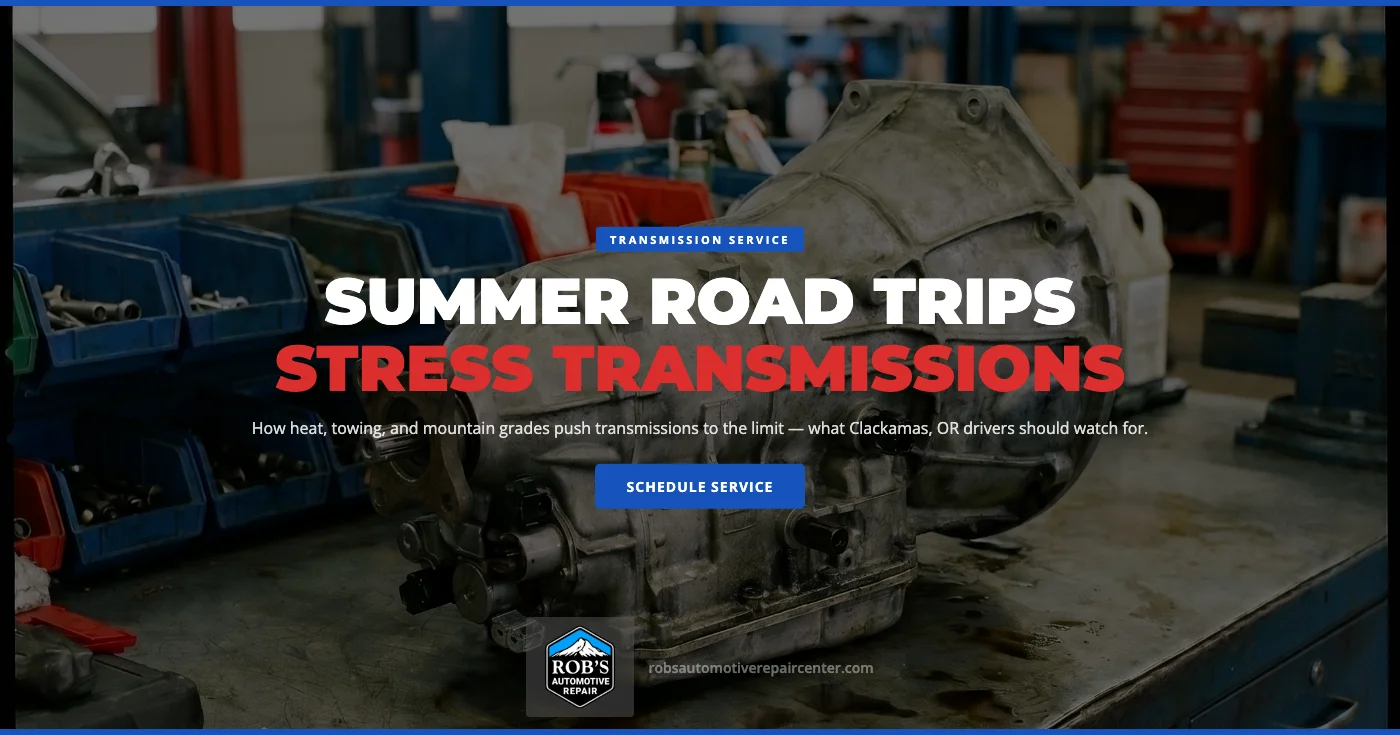
A family loads the SUV for Sunriver. A contractor hooks a trailer of Cascade lumber to a work truck. A retired couple points a motorhome south toward Crater Lake. Every one of those trips leaves Clackamas over Mount Hood, up I-84, or south through the Willamette Valley — and every one pushes a transmission harder than the rest of the year combined. A pre-trip transmission service Clackamas OR visit is the single most valuable hour of preventive maintenance a summer road-tripper can buy.
At Rob's Automotive Repair, we've kept Clackamas, Happy Valley, Oregon City, Milwaukie, Damascus, and Boring drivers rolling for 21 years from the same Highway 212 location. Our ASE Certified and dealer-trained technicians run a courtesy digital inspection on every visit, and any transmission concern — from a quick fluid check to a full auto transmission diagnostics Clackamas visit — gets a plain-language explanation of what we found.
Why Summer Road Trips Are Tough on Your Transmission
Your transmission is a heat engine as much as it is a gearbox. Every gear change and every torque-converter slip produces heat, and the transmission cooler — usually integrated with the radiator — has to shed all of it. On a March commute from Happy Valley to Portland, that job is easy. On a July climb up US-26 toward Government Camp with a boat behind you and 90-degree air coming through the grille, it isn't.
Three summer patterns stack the deck against your transmission at once:
- Sustained high load. A tow, a roof box, or a fully loaded vehicle keeps the torque converter working harder than it does around town.
- Long grades at reduced airflow. Climbing at 45 mph pushes far less air through the cooler than cruising at 65, exactly when the fluid needs cooling most.
- Higher ambient temperature. On a 95-degree afternoon in Damascus, there isn't much room between "hot enough to work" and "hot enough to fail."
The damage builds silently. Drivers often finish the trip with no complaint, then notice a lazy 2-3 shift or a freeway shudder a week later. By that point, the fluid is usually already burnt.
How Mountain Grades and Heat Stress Transmission Fluid
Transmission fluid is the lifeblood of your gearbox. It lubricates, cools, transmits hydraulic pressure through the valve body, and carries wear particles away from the clutches. According to AAA's automatic transmission fluid guide, a healthy automatic runs between roughly 175°F and 200°F under normal driving. Sustained above 220°F is a warning sign — and every 20°F rise above 200°F roughly cuts fluid life in half.
Now picture pulling a boat over Mount Hood or grinding up I-84 toward Hood River with a fifth wheel. The transmission is downshifting to hold speed, the converter is slipping harder against a heavier load, and airflow through the cooler is dropping because you're going slower. Fluid temperatures climb fast, and the fluid itself starts to change:
- Viscosity drops. The fluid can no longer form a protective film between metal parts, so wear on the clutches and pump accelerates.
- Additives break down. Friction modifiers, anti-wear compounds, and seal conditioners lose their chemistry.
- Varnish and sludge form. Residue restricts fluid passages in the valve body and causes the delayed, harsh shifts most drivers notice first.
Fresh ATF is bright red or pink and smells faintly sweet. Brown, black, or milky fluid means it's time for service — and a burnt-toast smell confirms it. Any driver who has towed on a warm day and can't remember the last time the transmission was serviced should have the fluid checked before the next big trip.
Warning Signs of Transmission Trouble Every Clackamas Driver Should Know
Transmissions almost always give warning before they fail. Here's what our technicians look for during a courtesy inspection, and what you should watch for between visits.
- Slipping. Engine revs but the vehicle doesn't accelerate — tachometer climbs, speedometer doesn't. Classic symptom of worn clutches or low fluid.
- Delayed engagement. Shift into Drive or Reverse and there's a one- or two-second pause before the vehicle moves.
- Hard or jerky shifts. A shift you can feel in your seat is worth investigating.
- Shudder under load. Vibration during light freeway acceleration around 40 to 55 mph usually points to torque-converter clutch trouble.
- Burning smell. Overheated fluid gives off a distinct acrid odor. If you smell it after a long climb, don't ignore it.
- Fluid color change. Brown, black, or milky fluid — or a burnt smell — means service is due.
- Whining or clunking sounds. Especially noticeable in neutral or when shifting.
- Warning light. Modern vehicles log a code before the driver feels the problem. If a light comes on, get it scanned.
- Sudden drop in fuel economy. Slipping wastes energy. If your MPG falls suddenly, the transmission may be part of the story.
Any single symptom is worth a stop-in. Two together — especially heading into a road trip — often means transmission repair Clackamas customers should schedule before the miles pile up.
Automatic, Manual, and CVT: How Service Differs
Not every transmission is serviced the same way. One of the most common questions we get from Happy Valley and Oregon City drivers is which category theirs falls into.
Automatic transmissions are still the most common on Oregon roads. They use a torque converter, a planetary gear set, and a valve body full of solenoids. Fluid changes are typically due every 60,000 to 100,000 miles under normal service, but manufacturers universally shorten that interval for "severe duty" — towing, mountain driving, sustained heat, and stop-and-go traffic. Most Clackamas drivers who tow, commute over US-26, or spend summers on the road fall squarely into severe duty.
Manual transmissions use gear oil rather than ATF. With no torque converter and no hydraulic control system, they run cooler and tolerate longer intervals — often 60,000 to 90,000 miles. Worn synchronizers, notchy shifts, and grinding on the 2-3 downshift are common signs the gear oil needs attention.
CVT (continuously variable) transmissions live on many newer Nissans, Subarus, Toyotas, and Hondas we see in Clackamas. Instead of fixed gears, a CVT uses a steel belt or chain running between two variable-diameter pulleys. CVTs are more sensitive to fluid condition than either automatics or manuals; manufacturers typically recommend service every 30,000 to 60,000 miles. Using the wrong specification of fluid can ruin a CVT — our team pulls the exact factory spec for your vehicle before we touch one.
When to Schedule a Fluid Change vs. Full Service
There's a real difference between a fluid change and a full transmission service, and choosing the right one saves time and money.
A fluid drain-and-fill removes 30 to 50 percent of the fluid — the amount in the pan. It's quicker and less costly, and works well for a scheduled interval on a healthy transmission that has never been badly overheated.
A full transmission service drops the pan, cleans the internal magnet, replaces the filter or screen, inspects for metal debris, and refills with the correct fluid. On many vehicles we follow that with a machine-assisted exchange that flushes closer to 100 percent of the old fluid. Any transmission fluid service Oregon drivers get from us includes a walk-through of what came out of the pan.
For most Clackamas drivers who tow, drive mountain roads, or have never had their transmission serviced: go with the full service, especially if the fluid has more than 50,000 miles on it or has turned brown. Every transmission service Clackamas OR customers get from us is backed by our 4-year/48,000-mile local warranty and 3-year/36,000-mile nationwide coverage.
Between transmission visits, keep the rest of your fluids on schedule. A neglected oil change is often the first sign a vehicle isn't getting preventive attention.
Pre-Road-Trip Transmission Checklist for Clackamas Drivers
Before you point the vehicle at Mount Hood, the Oregon Coast, or Bend, work through this list — or drop by and we'll go through it with you.
- Check transmission fluid level and condition. With the engine warm on most vehicles (some newer transmissions are sealed and require a shop-level check), verify the level and inspect color and smell.
- Confirm the service history. If you can't remember the last transmission service and the vehicle has more than 60,000 miles on it, it's time. If you tow or commute over the mountain regularly, that number drops to 30,000 to 45,000.
- Verify cooling system health. Old coolant, a weak fan clutch, or a blocked radiator will all raise transmission temperatures on a climb.
- Inspect for leaks. Any red or brown fluid on the driveway is worth investigating before you head into the mountains.
- Know your towing capacity. Exceeding the manufacturer's tow rating is the fastest way to cook a transmission. If you're pulling a new-to-you trailer, look up the number before you leave.
- Plan for cool-down stops. On long grades with a load, use pullouts. Idling in Neutral for a minute lets airflow catch up.
- Book a courtesy inspection. Every vehicle that comes into our Clackamas shop gets one at no charge — the fastest way to catch a small issue before it derails a vacation.
We ask families, fleet owners, and weekend adventurers alike to give us a few days' notice before a big trip. If we find something that needs parts, we want time to do the job right.
Trusted Transmission Service in Clackamas at Rob's Automotive Repair
Rob's Automotive Repair has served drivers in Clackamas, Happy Valley, Milwaukie, Oregon City, Damascus, and Boring since 2005. Our team is ASE Certified and dealer-trained, which matters more on transmission work than almost any other repair — modern transmissions are precision assemblies, and a diagnosis is only as good as the technician reading the data.
We treat every vehicle the same — family sedan, work truck, European sport sedan, or fleet pickup. We inspect digitally, walk you through the findings, quote the work up front, and stand behind it. New customers get 20 percent off the first visit, and every service earns 3 percent back through our rewards program. If your transmission is due or you've noticed a warning sign before a summer road trip, our Transmission Service team is ready. Book online or stop by, weekdays 7 am to 6 pm.
Frequently Asked Questions About Summer Transmission Service in Clackamas
How does summer road trip driving affect my transmission?
Summer heat, mountain grades, and towing all raise transmission fluid temperatures. Above roughly 220°F, fluid loses its ability to lubricate and cool, and every 20°F increase over 200°F roughly halves fluid life. Long climbs like US-26 over Mount Hood or I-84 to Hood River are exactly the kind of duty cycle that shortens transmission life if the fluid isn't in good shape.
When should I service my transmission in Clackamas, OR?
For most automatic vehicles, plan on a fluid service every 60,000 to 100,000 miles under normal driving, and every 30,000 to 60,000 miles if you tow, drive in the mountains, or sit in traffic often. CVT-equipped vehicles typically need service every 30,000 to 60,000 miles regardless of driving style. Manuals stretch to 60,000 to 90,000. Our team will check the fluid and service history and give you a straight answer.
What are the warning signs of transmission trouble?
Slipping, delayed engagement, hard or jerky shifts, shudder under acceleration between 40 and 55 mph, a burning smell, brown or milky fluid, whining or clunking sounds, a dashboard transmission warning light, and a sudden drop in fuel economy. Any single symptom is worth a scan; multiple symptoms are worth immediate attention, especially before a summer road trip car service Clackamas OR drivers depend on to make it home.
Where can I get transmission service near Clackamas?
Rob's Automotive Repair on Highway 212 in Clackamas provides full transmission diagnostics, fluid services, and repair for automatic, manual, and CVT vehicles. Every service is backed by our 4-year/48,000-mile local warranty and 3-year/36,000-mile nationwide coverage, and we serve Clackamas, Happy Valley, Oregon City, Milwaukie, Damascus, and Boring weekdays 7 am to 6 pm.