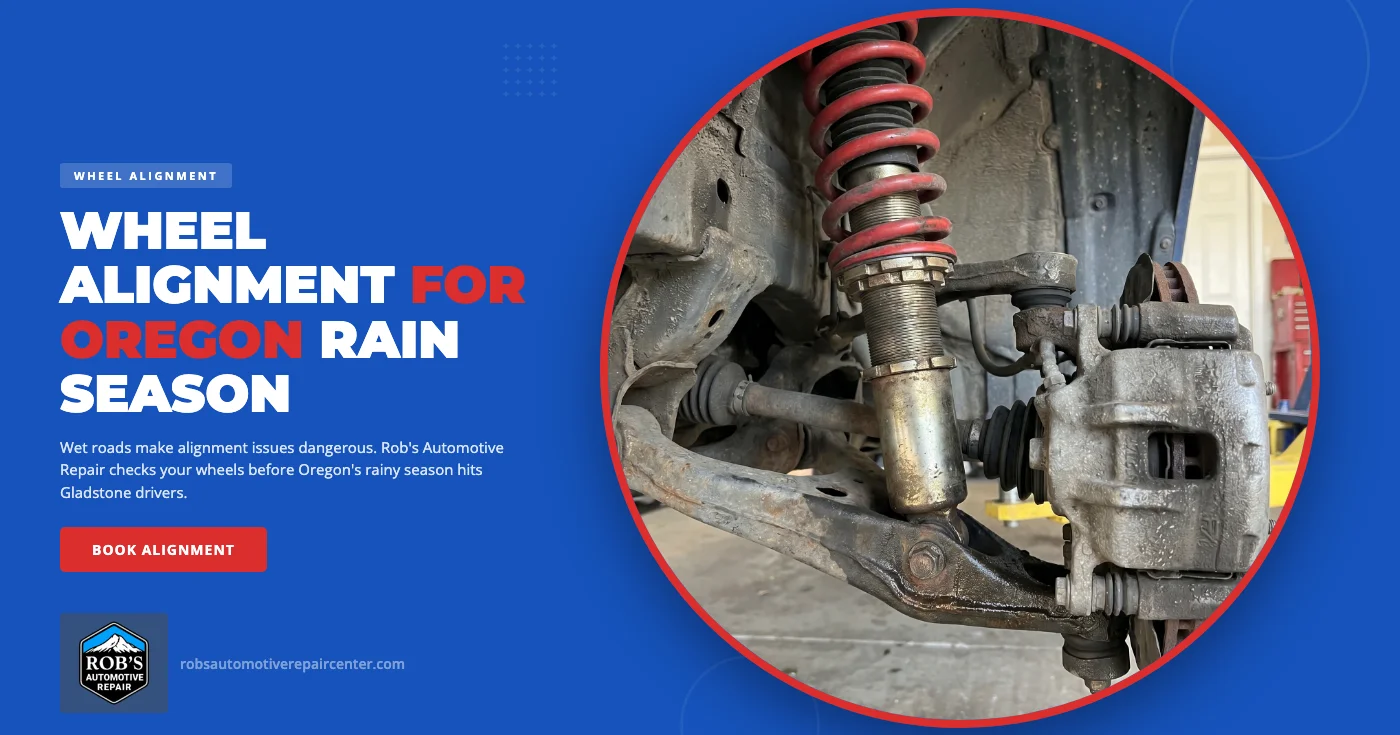
Get your wheels aligned before Oregon's rainy season hits. Rob's Automotive Repair serves Gladstone drivers with expert wheel alignment and suspension service.
The rain returns to Gladstone the same way every year — a few overcast mornings in mid-September, then a Sunday downpour that puddles McLoughlin Boulevard from Portland Avenue to the I-205 exit. By October the pavement stays slick for eight straight months, and if your wheels are out of alignment, that's where quiet summer wear turns into unpredictable wet-road handling. A pre-fall wheel alignment gladstone or drivers can count on catches those small shifts before rainy-season pavement makes them a problem.
At Rob's Automotive Repair, we've cared for Gladstone, Clackamas, Happy Valley, Milwaukie, Oregon City, Damascus, and Boring drivers for 21 years from our Highway 212 shop. Our ASE Certified and dealer-trained technicians run every alignment on a new Hunter rack and follow it with a courtesy digital inspection — photos of anything we flag, emailed to your inbox. Here's what every Gladstone driver should know about how summer roads throw alignment off, the warning signs to watch for, and when to book a check before the wet season sets in.
Why Oregon's Summer Roads Are Hard on Your Wheel Alignment
Gladstone's roads work overtime through July and August. McLoughlin Boulevard, Portland Avenue, 82nd Drive, and the cross-county arterials take a beating from summer traffic peaks and freeze-thaw damage left over from last winter. Every raised patch, sunken utility cover, and rippled seam of asphalt lands as a lateral load on your suspension — and it's the geometry, not the shocks alone, that decides whether your wheels stay pointed straight.
- Pothole and edge-impact hits. A hard strike on the frost-heaved sections of Abernethy Road or the patched shoulders along Highway 213 can push a control arm out of position by a fraction of an inch — enough to shift toe or camber by half a degree with nothing visibly bent.
- Curb strikes and construction detours. Summer road-work reroutes send Gladstone commuters into unfamiliar lanes and tighter merges. A curb strike at 8 mph transfers enough force to move a tie-rod end.
- Heat and rubber fatigue. Control-arm bushings, sway-bar mounts, and strut bearings hold suspension geometry in place. Prolonged Willamette Valley heat dries and hardens the rubber, so mid-corner loads shift the wheel angle instead of being absorbed cleanly.
None of these trigger a warning light. They show up months later as feathered tread, a wheel that no longer centers, or a set of tires that comes off 10,000 miles early.
Warning Signs Your Car's Alignment Is Off: A Gladstone Driver's Checklist
Alignment problems show up in feel and sound long before a warning light — which is why so many Gladstone drivers miss them until the wear pattern is already set. Signs our technicians see most often:
- Steering pull on a level road. A car that drifts on a flat stretch of I-205 toward the Gladstone exit is the classic tell. Light pull can be a tire issue; strong pull points to alignment.
- Off-center steering wheel. If your logo isn't level going straight, geometry has shifted or a recent tire installation didn't reset the wheel.
- Tires squeal in slow turns. Scrubbing through a corner or parking-lot roundabout points to toe out of spec.
- Feathered tread edges. Run your hand across the tire from inside to outside. Smooth one way and rough the other means toe is off and tread is being dragged sideways.
- Uneven shoulder wear. Worn inside edge = negative camber gone too far. Worn outside edge = positive camber. Either needs correcting on the Hunter rack.
- Vibration or loose steering above 45 mph. Sometimes a balance issue, but often the result of tires worn into scalloped patterns from an underlying alignment shift.
Any one is worth a check. Two or more together means the geometry has shifted, and every mile after is grinding tread into a pattern rotation alone can't fix.
How Misalignment Affects Fuel Economy and Tire Wear on Pacific Northwest Roads
When your wheels aren't pointing the direction the car is traveling, the tires are dragged sideways at every rotation. That drag becomes rolling resistance the engine has to overcome — and rolling resistance costs fuel.
According to the U.S. Department of Energy's fuel-economy guidance, under-inflated tires alone drop gas mileage by roughly 0.2% per 1 psi below spec across all four tires — a clean illustration of how rolling resistance and fuel use link up. Layer an alignment issue on top and the drag compounds. On a Gladstone commuter running to downtown Portland or up to the industrial parks in Clackamas, a 2-3% mileage drop stacks up over a year of driving.
The tire-wear cost is bigger. Feathered or shoulder-worn tread shortens tire life measurably — a set that should have delivered 60,000 miles often comes off at 40,000 or 45,000. Because Pacific Northwest driving demands even tread depth for wet-road traction, replacing a set early isn't preference. A single alignment on our Hunter rack, caught before the wear is baked in, usually pays for itself in prevented tire replacement long before the rain arrives. Two knock-on effects: brake pads and rotors on the pulling corner wear faster, and CV joints and wheel bearings load unevenly when camber is out of spec.
Wheel Alignment vs. Tire Rotation: Understanding the Difference in Gladstone, OR
The two services get confused all the time — but they solve different problems, and doing one doesn't replace the other.
A tire rotation moves each tire to a different position so wear evens out across all four corners. Front tires steer and, on front-wheel-drive cars, accelerate too, so they wear faster than the rear. Rotation doesn't touch suspension geometry, and it doesn't correct pull or drift.
A wheel alignment adjusts the angles the wheels sit at relative to the road. Three angles are measured and corrected:
- Toe — whether the wheels point straight ahead, inward, or outward.
- Camber — whether the top of the wheel tilts inward or outward from vertical.
- Caster — the forward or backward tilt of the steering axis, which controls how well the wheel returns to center after a turn.
A rotation on a car that's out of alignment just moves the bad wear to a new corner — six months later the feathered pattern shows up on whichever tire moved to the front-left. The rotation is doing its job; the alignment is what needs correcting. Most Gladstone drivers who ask us about a tire alignment gladstone or service producing early front-tire wear actually need both. When you book both, we do the alignment first so the rotation lands on tires seeing the road correctly. Our combined Tire Service and alignment usually fits in a single half-day visit.
When to Schedule an Alignment Check Before Oregon's Rainy Season
The best window for an alignment check gladstone oregon drivers should book is late August through mid-September — after the summer road impacts and before the first heavy October storm. Alignment done in advance means dry test drives and no rushing the diagnosis.
A few situations push you to book sooner:
- Recent pothole hit or curb strike. If the steering feel changed afterward, get the geometry checked. Damage inside a bushing or tie-rod end doesn't always show on a visual inspection.
- New tires going on. A new set deserves correct geometry from mile one. Otherwise the wear pattern begins forming immediately.
- Steering wheel that isn't centered. Even mild off-center indicates the geometry has moved.
- Front tires wearing faster than expected. Feathering or shoulder wear ahead of schedule is an alignment cue we act on before the pattern grows.
- Any suspension work. Every strut, control arm, or tie-rod replacement resets the geometry and requires an alignment on the same visit.
For most Gladstone drivers, an alignment check every 12,000 to 15,000 miles is a reasonable baseline. Freeway commuters on I-205 or vehicles that regularly haul loads should skew shorter — a cautious annual check is a small line item and a large one prevented from the tire bill.
How Rob's Automotive Keeps Gladstone Drivers' Wheels Properly Aligned
Our alignment process at the Highway 212 shop starts with the car level on the Hunter rack. Sensors clamp to each wheel and measure toe, camber, and caster on all four corners to a fraction of a degree, against factory spec. Before any adjustment, we walk the customer through the readings on-screen if they want to see them. A full Wheel Alignment visit — the wheel alignment service clackamas drivers book most often — includes:
- Pre-alignment inspection. Tie-rod ends, ball joints, control-arm bushings, sway-bar links, and wheel bearings — any wear that would push geometry back out of spec is flagged first.
- Tire pressure set to the door-jamb placard, cold. Readings are only as accurate as the tire footprint they measure against.
- Four-wheel angle measurement. Toe, camber, and caster on all four wheels, plus thrust angle.
- Adjustment to factory spec. Camber shims or eccentric cams where available, toe on the tie-rods, caster on the front where possible.
- Steering wheel centered and post-alignment test drive. A short loop onto Highway 212 verifies the car tracks straight and no pull remains.
- Written digital report with photos. Emailed to your inbox before you leave, showing before/after readings for every angle.
A full suspension repair gladstone or service or a straightforward alignment is backed by our 4-year/48,000-mile local warranty and 3-year/36,000-mile nationwide warranty on parts and labor. New customers get 20% off the first visit, and every service earns 3% back through our rewards program. Rob's Automotive Repair has cared for Gladstone drivers since 2005 from the same Highway 212 shop in Clackamas — a short hop off I-205 and Highway 213. Open Monday through Friday, 7 am to 6 pm.
Frequently Asked Questions About Wheel Alignment in Gladstone, OR
How do I know if my car needs a wheel alignment?
Watch for a steering wheel that isn't centered, a car that pulls on a level stretch of I-205, uneven shoulder or feathered tread wear, or a squeal in slow turns. A recent pothole hit or curb strike is worth a check even if nothing feels different — geometry can shift internally without visible damage.
How often should Gladstone drivers get a wheel alignment?
Every 12,000 to 15,000 miles is a reasonable baseline. Freeway commuters and drivers who tow should skew shorter. Any strut, control arm, or tie-rod replacement requires an alignment on the same visit.
Does a pothole hit really require an alignment check?
Often, yes. A hard impact on Abernethy Road or the patched sections of Highway 213 can shift toe, camber, or caster enough to accelerate tire wear without being visible. If the steering feel changed after the hit, book an alignment before the wear pattern sets in.
Will a wheel alignment help my gas mileage?
Yes. Misaligned wheels drag sideways across the pavement, adding rolling resistance. Correcting the geometry reduces that drag and typically returns a couple of percent of lost fuel economy — small per tank, meaningful across a year.
Where can I get a wheel alignment in Gladstone, OR?
Rob's Automotive Repair on Highway 212 in Clackamas — a few minutes from Gladstone via I-205 — runs every alignment on a new Hunter rack and follows it with a courtesy digital inspection. Backed by our 4-year/48,000-mile local warranty and 3-year/36,000-mile nationwide warranty.
Book Your Alignment Check Near Gladstone Before Rain Season Arrives
The dry weeks between now and the first serious fall storm are the right window to get four wheels measured and locked in on factory spec. Waiting until the pavement is already wet turns an alignment visit into a stressful one. If it's been more than 12,000 miles or a year since your last alignment — or if the car has taken a pothole hit, a curb strike, or a new set of tires since — book this month. Stop by our Clackamas shop on Highway 212 or book online. We'll back it with the warranty coverage that's kept Gladstone, Clackamas, Happy Valley, Milwaukie, Oregon City, Damascus, and Boring drivers coming back since 2005.